AGENT-READY AV
What AI agents need from your video infrastructure
A capture fleet is agent-ready when an AI agent can read its state, act on it, and report back over an open protocol. Epiphan MCP gives Claude and ChatGPT read and write access to the Pearl fleet today, so an agent can check a room and fix it in the same conversation.
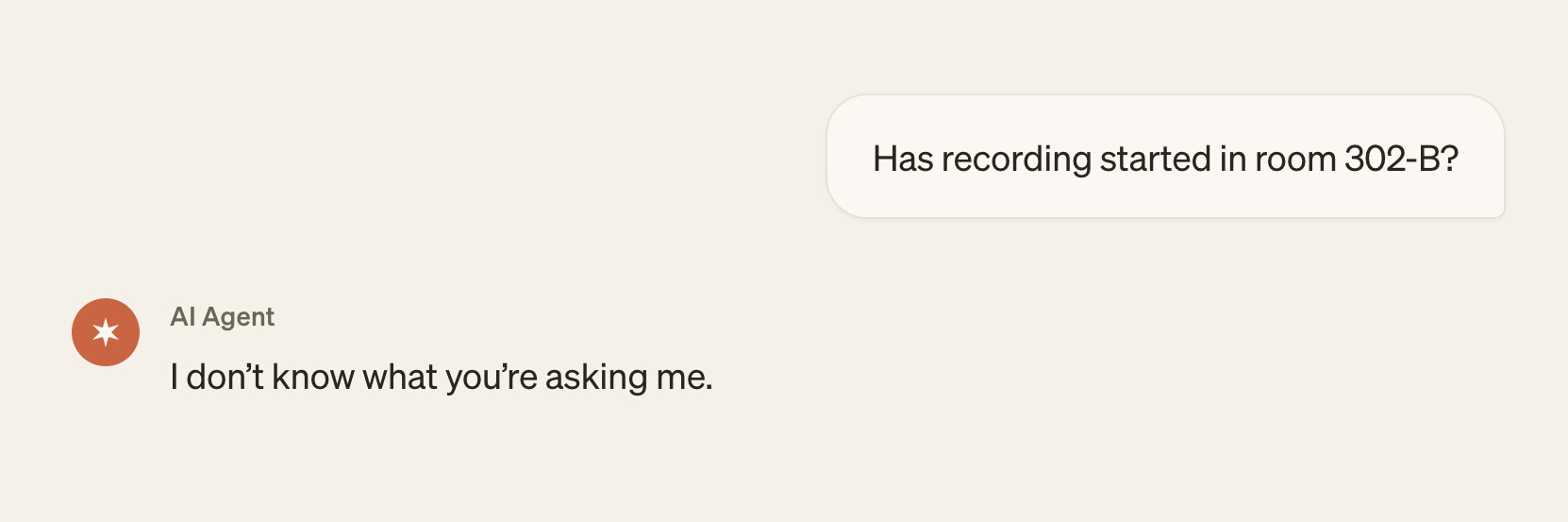
A capture fleet is agent-ready when an AI agent can ask it questions and act on it without a human translating in between. That means open interfaces, structured data about what each device is doing, and a control plane the agent can reach over a standard protocol. Most AV infrastructure today is not built this way. An agent that wants to know whether a recording started in room 320-B has to be taught how to ask, every time, by a human who already knows the answer.
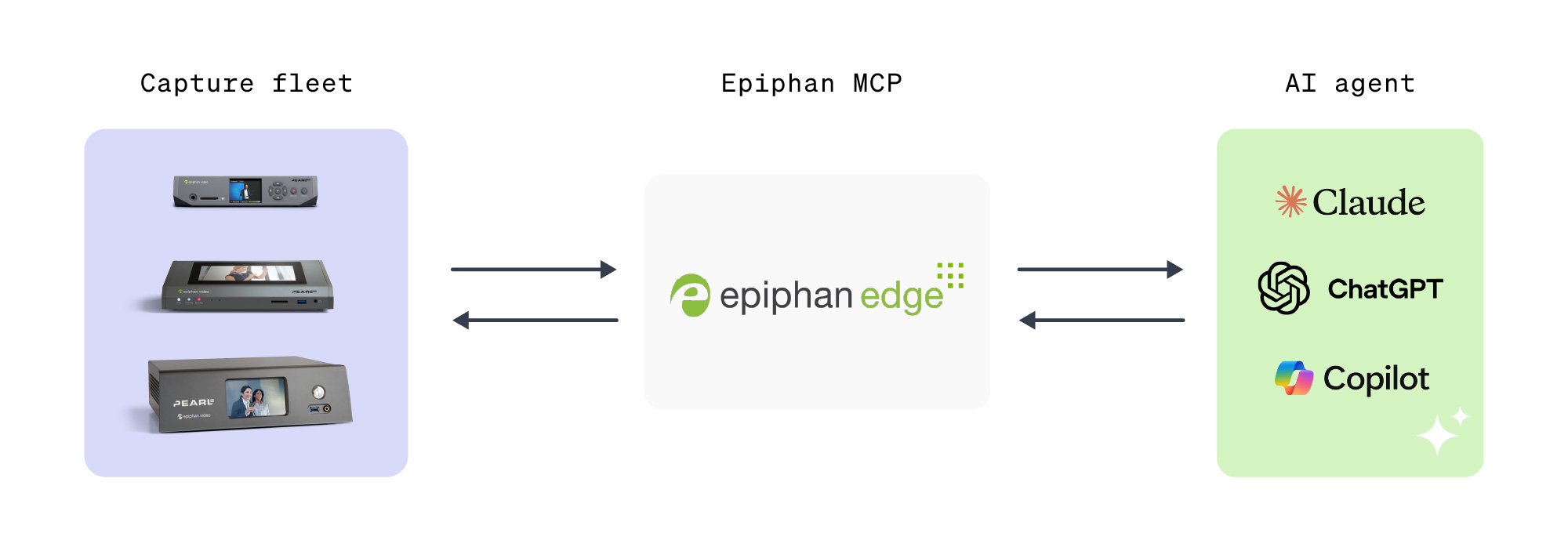
That gap is the thing this page is about. Epiphan MCP, a Model Context Protocol server hosted on Epiphan Edge, closes it today. Any MCP client can query live device status, channel health, storage, and scheduled CMS events across a Pearl fleet. With Epiphan Edge Premium, which you can try free for one month, the same agent can start and stop recordings, run streams, manage scheduled events, apply presets, and update firmware, with the user approving each change.
“Think of MCP like a USB-C port for AI applications. Just as USB-C provides a standardized way to connect your devices to various peripherals and accessories, MCP provides a standardized way to connect AI models to different data sources and tools.” — Model Context Protocol
Why this matters now
AI agents have moved past chat. The ones your staff are starting to use, including Claude, ChatGPT, and Copilot, can take action once they have the right interfaces, and the AV estate they will be pointed at is large. AVIXA projects the pro AV market will reach $402 billion by 2030, up from $332 billion in 2025, and HETMA puts higher-education AV alone at over $27 billion in annual spend.
The cost of that technology failing is measured in people, not just downtime. In an AVIXA and Logitech survey, 1 in 3 faculty and 1 in 4 students said they had seriously considered leaving their institution because of poor technology. Anthropic’s Model Context Protocol, released in late 2024, is the standard gaining traction for connecting agents to real systems, and several AV vendors have started publishing MCP servers for device fleet management.
What’s missing from those MCP announcements is the signal-path layer. Cloud-based management platforms know whether a camera is online. They do not know what the camera is seeing, whether the right source is selected, whether audio levels are correct, or whether the recording is reaching its destination. Those questions live inside the capture device, and answering them is what Pearl has done for thousands of customers for over a decade. The agent-ready opportunity for Epiphan is exposing that knowledge through an open protocol so any AI tool can act on it.
Here is what an interaction inside your AI tool might look like:
This isn’t theoretical. The Pearl fleet has been doing the reliable capture work that any agent layer has to sit on top of, for years. At UNLV, Frank Alaimo, Manager of Classroom Technology Services, runs Pearl Nexus in every centrally managed classroom: “I’m a happy man when my phone’s not ringing because I know everything is working. It allows my team time to focus on other things.”
On using Pearl Nexus with Epiphan Edge: "I'm a happy man when my phone's not ringing because I know everything is working. It allows my team time to focus on other things."
What an agent actually needs to be useful
An AV agent that helps a campus IT team has to do four things reliably:
- See device state across the fleet without a human polling each one.
- Read structured data about what each device is doing right now, including capture state, signal status, downstream platform health, and storage.
- Take action when authorized, including starting and stopping recordings, switching sources, adjusting layouts, and rebooting devices.
- Report back in plain language a human can verify.
None of that requires the agent to be smart about AV. It requires the AV infrastructure to be legible to the agent. The smart part lives in the agent you already trust. Epiphan’s job is to make the gear answer questions accurately, act on instructions safely, and respect the security boundaries your IT team has set.
Five scenarios, and where they stand today
Epiphan’s agent-ready AV work focuses on five scenarios our customers ask about repeatedly. With read and write access live, an agent can now handle the checks and most of the fixes in scenarios 1, 2, and 4, and the preset part of scenario 5. Room utilization analytics, scenario 3, is still on the roadmap.
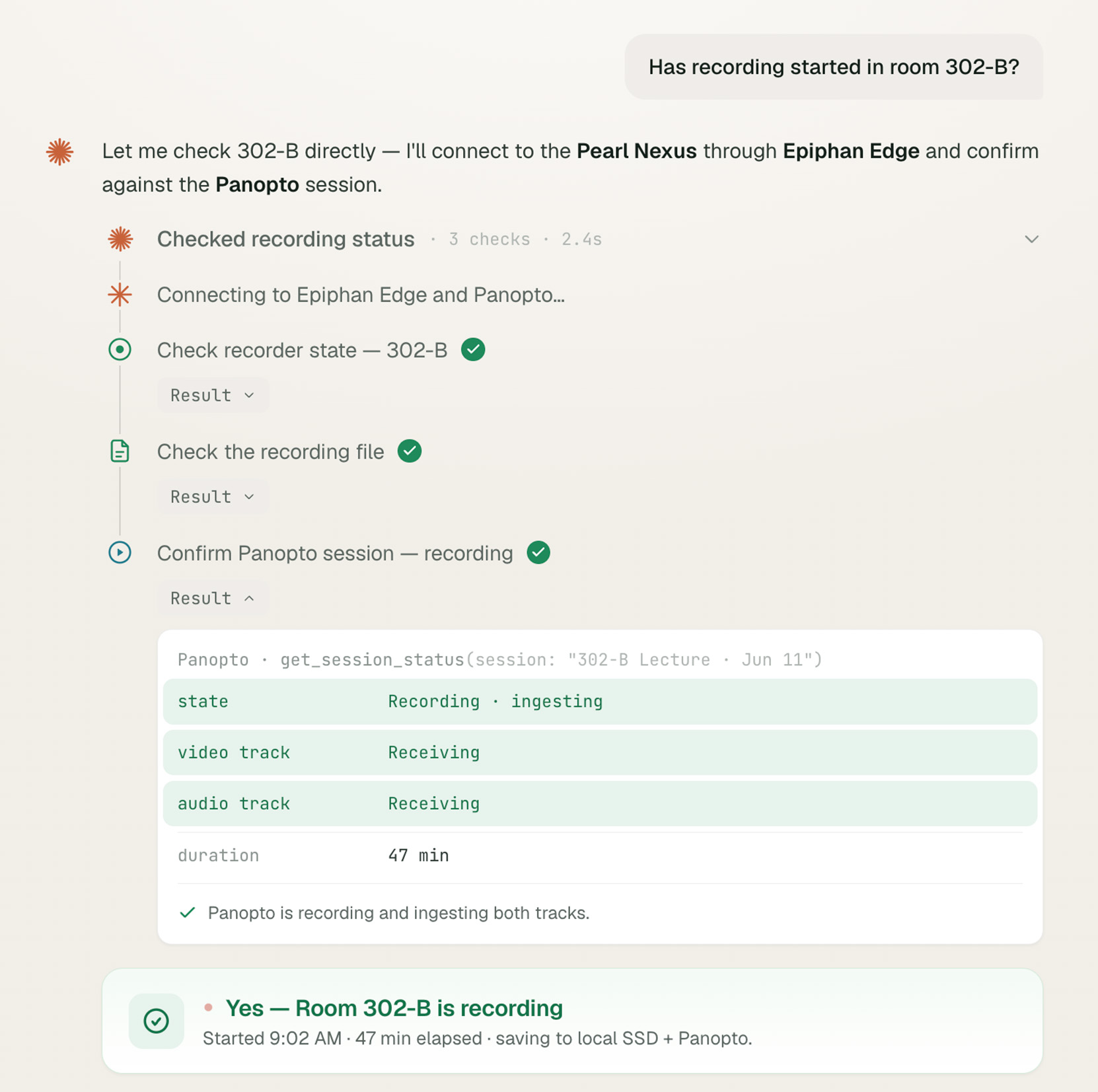
1. Why is room 302-B down?
Lecture capture troubleshooting takes hours today when a recording fails. The question of whether the cause is the network, the encoder, the room control system, the CMS, or the user requires customer IT teams to walk buildings and stitch logs. An agent with access to Epiphan Edge can pull device logs, network telemetry, capture state, and CMS health into one answer.
Here is what this might look like in your AI agent UI:
2. Is the room ready before class begins?
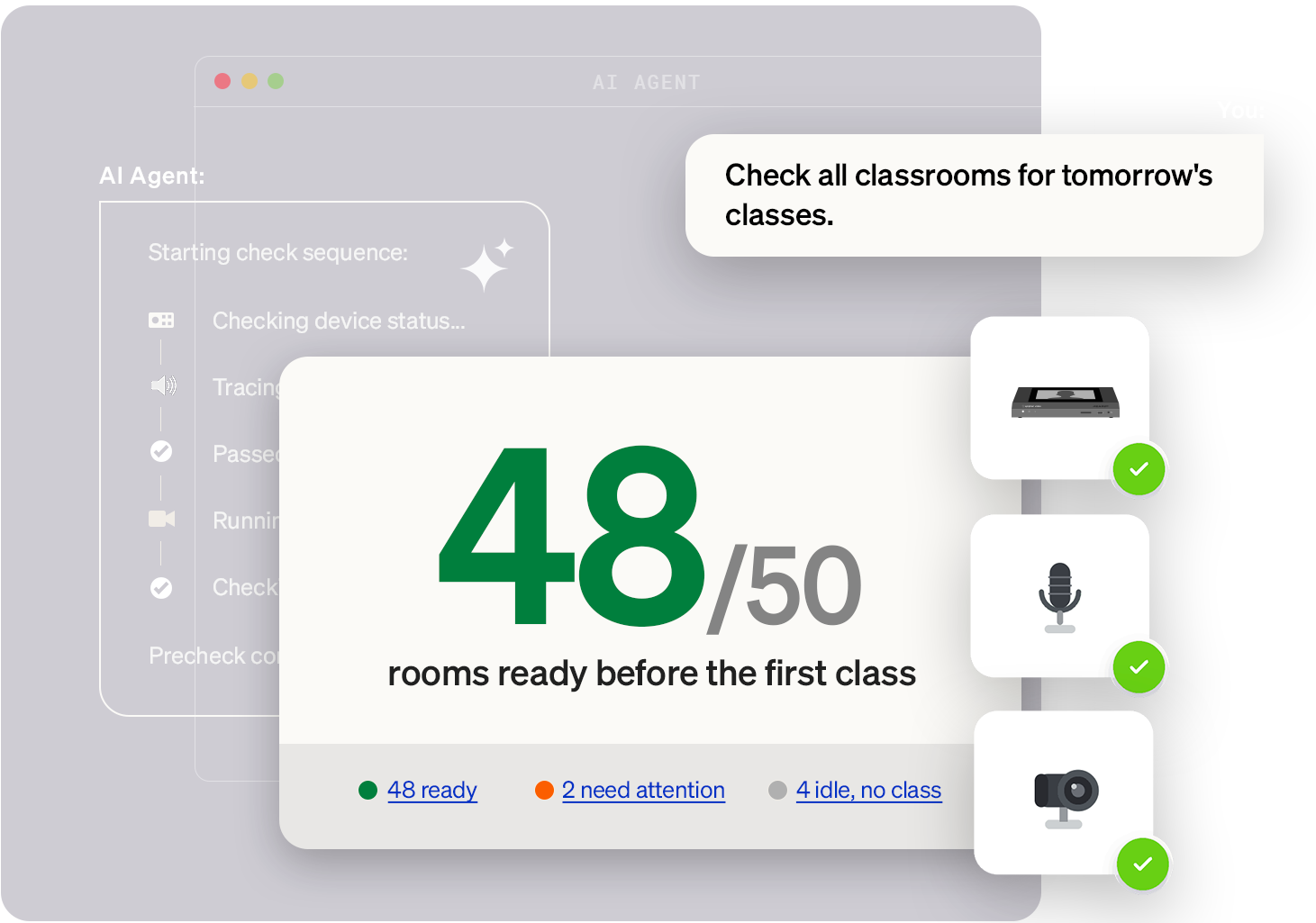
Classroom AV preflight is manual work today. AV teams walk rooms, or run manual checks over the network before classes, because they have no alternative. The cost of discovering at 9:05 a.m. that audio was off is too high. A scheduled preflight run by an agent returns clear pass-fail status before first class, every day, across the whole fleet. MTSU’s James Copeland deployed 428 rooms in three months with a staff of two, the kind of fleet a daily preflight has to cover.
Example preflight dashboard:
3. Which rooms actually get used?
Classroom utilization data already exists inside the video Pearl captures. Attendance counts, room activity, and timing patterns. Adam Finkelstein at McGill University found roughly 50 percent of the institution’s small classrooms sat unused, because no one knew where they were or how to book them (EDUCAUSE Review, October 2025). Turning that footage into numbers takes AI vision applied to the captured stream, which is where Epiphan’s agent-ready work is heading. NC State recorded over 4 million views across two semesters of expanded capture, the kind of footage those numbers come from. Institutional leaders make capital and staffing decisions about their AV fleets without that data today because no one surfaces it.
4. Is the encoder fleet ready before doors open?
Live event preflight means walking the floor and manually clicking through interfaces today. Producers running multi-camera, multi-room productions can spend hours before doors open on this work. An agent can verify devices online, signals expected, profiles loaded, redundant streams configured, storage available, and destinations reachable in a fraction of that time.
5. Configure Pearl by saying what you want
Natural-language configuration removes the specialist knowledge requirement for routine setup tasks. Configuring a Pearl today requires understanding the interface. Today an agent can apply a saved preset to a group of devices on request. Broader plain-language configuration is the next step, meaning faster setups and a lower barrier to entry for inexperienced users.
For example:
Where agent-ready AV fits in your stack
The architecture is straightforward. Your AI tool, whichever one you’ve standardized on, talks to Epiphan Edge over MCP. Epiphan Edge handles the fleet, exposes capture state, and connects to partner systems where it makes sense. The Pearl devices in each room do what they’ve always done. The agent gets a consistent interface across whichever AI tool you’ve chosen, without Epiphan committing you to a particular vendor’s AI.
You manage the AI. We give you visibility into the hardware in the signal path, the cloud platform that connects the fleet, and the channel relationships with Panopto, Kaltura, Echo360, and the room control vendors. An agent without that foundation is asking questions of a black box. An agent with it can act.
The University at Buffalo runs nearly 200 centrally scheduled rooms across three campuses on Pearl Nexus, and NTNU in Norway is targeting 700 rooms with more than 100 Pearl Mini already deployed. Adam Pellittieri, Classroom Systems Engineer at the University at Buffalo, describes the capture foundation his team relies on: “We haven’t missed a single recording with Nexus. Everything has gone off without a hitch, and now we have more time to innovate and take on new projects.” The agent-ready layer adds the interfaces that let an agent ask questions of that foundation and act on it.
Put your assistant to work
Write access to Epiphan MCP is available now with Epiphan Edge Premium, and you can try Premium free for one month. Asking about your devices stays free with any Epiphan Edge account.
Common questions
Agent-ready AV is video and streaming infrastructure designed so AI agents can read device state, act on instructions, and report back over an open protocol. The agent doesn’t have to be smart about AV. The AV infrastructure has to be legible to the agent. Most AV systems aren’t built this way today.
Model Context Protocol is an open standard released by Anthropic in late 2024 for connecting AI agents to external systems. It defines how agents discover what a system can do, ask for information, and request actions. Applied to AV, MCP lets your AI tool talk to a video capture fleet without custom integration work for every vendor.
Yes. Epiphan MCP is live. With any Epiphan Edge account, Claude, ChatGPT, or another MCP client can query device info, system and storage status, channel settings, live channel images, audio levels, and scheduled CMS events. With Epiphan Edge Premium, which you can try free for one month, it can also start and stop recordings, manage streams and scheduled events, apply presets, reboot devices, and update firmware.
Access is granted through OAuth using your own Epiphan Edge login and scoped to one Edge team, so an assistant sees only the devices you already manage and nothing else on your network. It can only do what your role in Epiphan Edge allows, and Claude and ChatGPT ask you to approve each write action. You can revoke the connection from Edge at any time.
Claude and ChatGPT are supported today, each with a step-by-step connect guide. Because Epiphan MCP follows the Model Context Protocol, any MCP-compatible client can connect using the same server address. Microsoft Copilot isn’t currently supported, and Gemini doesn’t offer MCP connectors in its web or mobile app. Choosing an open protocol means you do not have to standardize on the AI vendor Epiphan standardizes on.
The CMS partners stay where they are. Pearl continues to push captured content to whichever CMS you use. The MCP layer adds agent-readable status and control on top of that workflow, including downstream CMS health when partner systems expose it.